
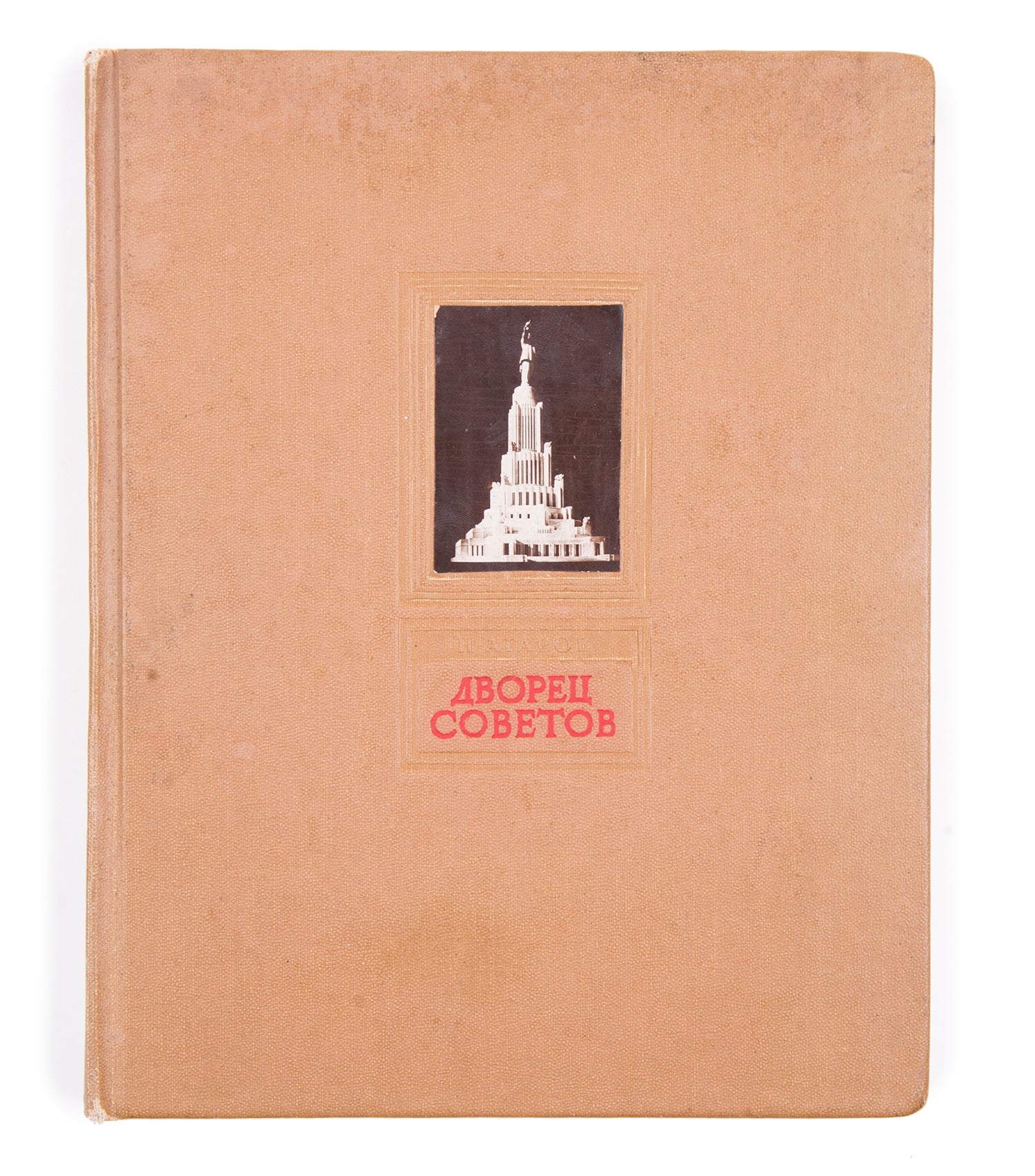
![Item #1177 [BEST BOOK ON THE PALACE OF SOVIETS] Dvorets Sovetov [i.e. The Palace of Soviets]. N. S Atarov.](https://bookvica.cdn.bibliopolis.com/pictures/1177.jpg?width=768&height=1000&fit=bounds&auto=webp&v=1612382354)
![[BEST BOOK ON THE PALACE OF SOVIETS] Dvorets Sovetov [i.e. The Palace of Soviets]](https://bookvica.cdn.bibliopolis.com/pictures/1177_2.jpg?auto=webp&v=1612382354)
![[BEST BOOK ON THE PALACE OF SOVIETS] Dvorets Sovetov [i.e. The Palace of Soviets]](https://bookvica.cdn.bibliopolis.com/pictures/1177_3.jpg?auto=webp&v=1612382354)
![[BEST BOOK ON THE PALACE OF SOVIETS] Dvorets Sovetov [i.e. The Palace of Soviets]](https://bookvica.cdn.bibliopolis.com/pictures/1177_4.jpg?auto=webp&v=1612382354)
[BEST BOOK ON THE PALACE OF SOVIETS] Dvorets Sovetov [i.e. The Palace of Soviets]
Moscow: Moskovskii rabochii, 1940. Item #1177
164 pp., 20 ills. 22x17,5 cm. In original cloth with lettering and a photograph mounted on the front cover; granite-patterned endpapers. Spine slightly rubbed, a few small and pale informal stamps of Soviet period, otherwise near fine.
First and only edition. One of 5000 copies. Very rare in this condition.
Good example of the book design produced by Solomon Telingater (1903-1969) and the finest edition glorifying the Palace of Soviets.
It well presented Telingater’s principle to make a book as a sophisticated artistic construction. Due to the great experience in type design and printing processes, Telingater was entrusted to do whatever he wanted in a printing shop. He could print and correct every page as many times as it took until he was satisfied. This particular mock-up was created with small monochrome drawings going along the text. They feature world constructions, some masterpieces of Soviet architecture built in the industrialization period, as well as various projects of the Palace of Soviets. Twenty inserts included photographs by A. Sorkin and drawings by Boris Rybchenkov, made on the construction site and captured those operations that had been really implemented. Apart from them, projects of the whole building and its parts, illustrations relating to its interior are featured. The granite-patterned endpapers resonated with the external facing of the building. One of the chapters was devoted to materials chosen. According to the book, several expeditions had been organized and only Caucasian light granite fitted the requirements.
The book comprehensively analyzed a project of the Palace of Soviets as a triumph of contemporary architecture, combining possible and nearly impossible. The number of decorations in the project was close to fantasy. For example, all wall-paintings together could have occupied an area comparable to six Red Squares. Involving folk art masters from all over the country, art objects of all techniques and materials were planned. Creators paid special attention to problems of acoustics, crowd arranging, electrification, cleaning and air supply - the whole Weather Factory was projected for air conditioning. Telephone, telegraph and post services were also supposed to be.
The author Nikolai Atarov (1907-1978) was not an architect, but a writer able to spectacularly tell about the main project of the century, a symbol of Soviet power and triumph, the center of new Moscow. “Borders of countries will disappear. Communist settlements, not similar to old cities, will arise. The Palace of Soviets, crowned with Ilyich statue, will still stand on the bank of the Moscow River”.
Worldcat shows printed copies located in Yale and North Carolina Universities.
Sold